AI Research Gather is a lightweight proof of concept for turning recent arXiv papers into compact podcast scripts. It still starts as a research triage tool, but the current repo has moved the product closer to a small production workflow: discover papers, select one, configure two speakers, generate a grounded dialogue, replay it, and export it.
The product is built around a small loop: find current papers, choose one, and convert it into a usable dialogue artifact.
The problem it solves is not long-term literature management. It is the gap between "what is new in this area?" and "can I turn this paper into something I can listen to, share, or adapt?" That first pass benefits from tight constraints instead of accounts, saved libraries, databases, or ingestion pipelines.
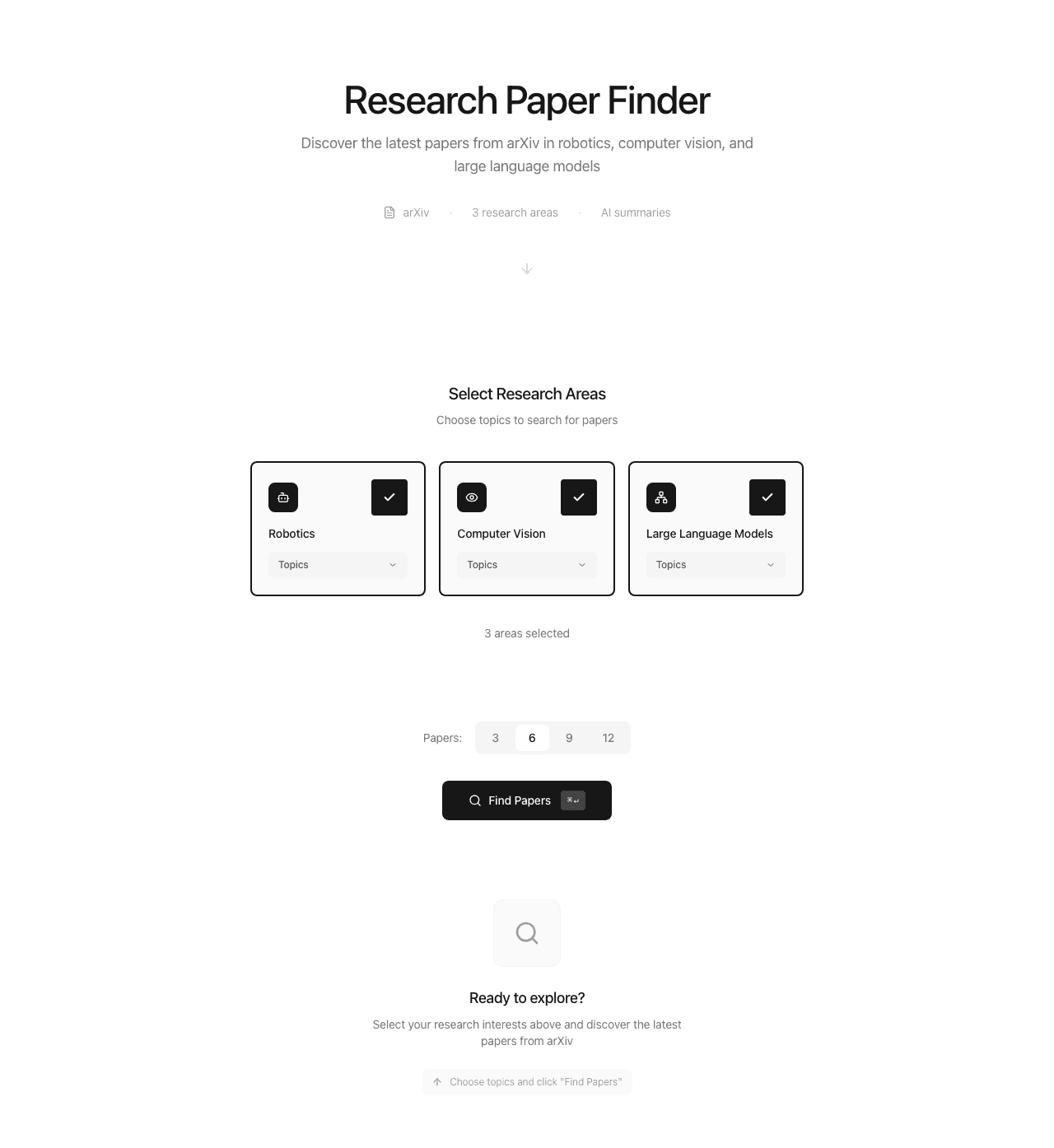
The discovery screen focuses on robotics, computer vision, and large language models. The user chooses areas, optionally narrows topics, picks a count of 3, 6, 9, or 12 papers, then searches live arXiv results. The paper cards keep the title, authors, publication date, source, and abstract close to the action that sends a paper into script production.
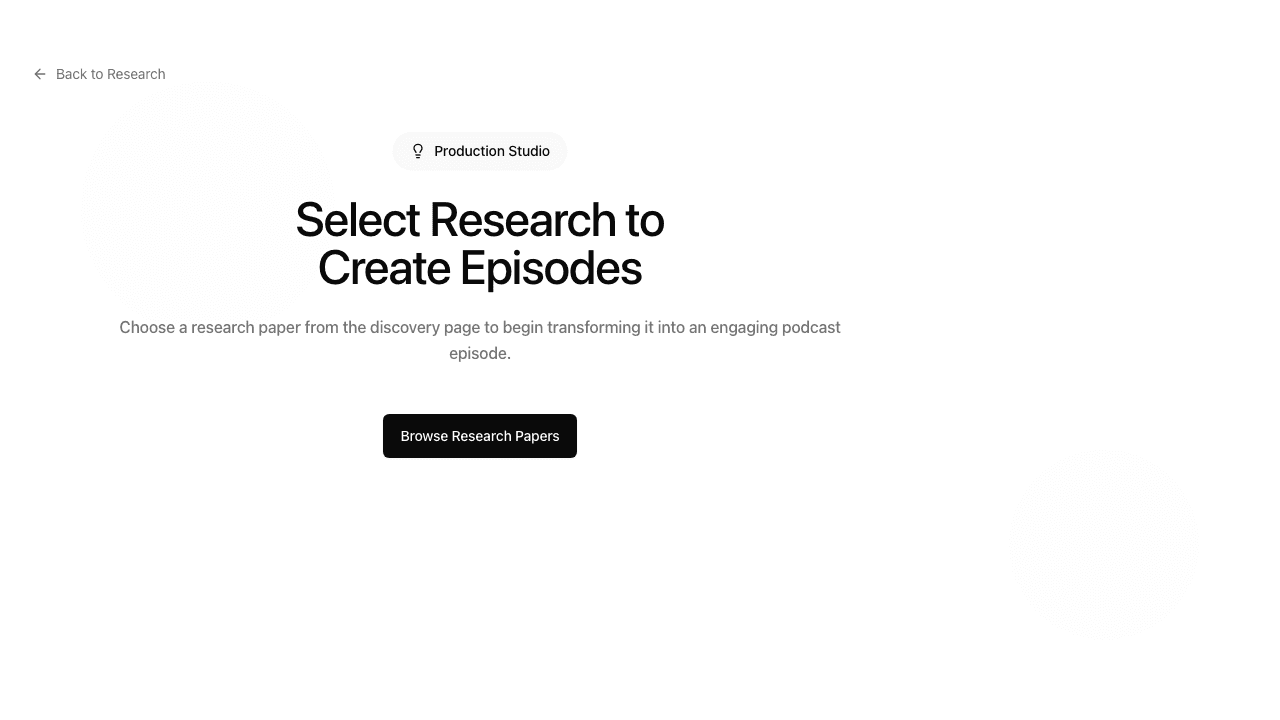
Discovery and production are separate states so the user does not spend model calls before deciding which paper deserves attention.
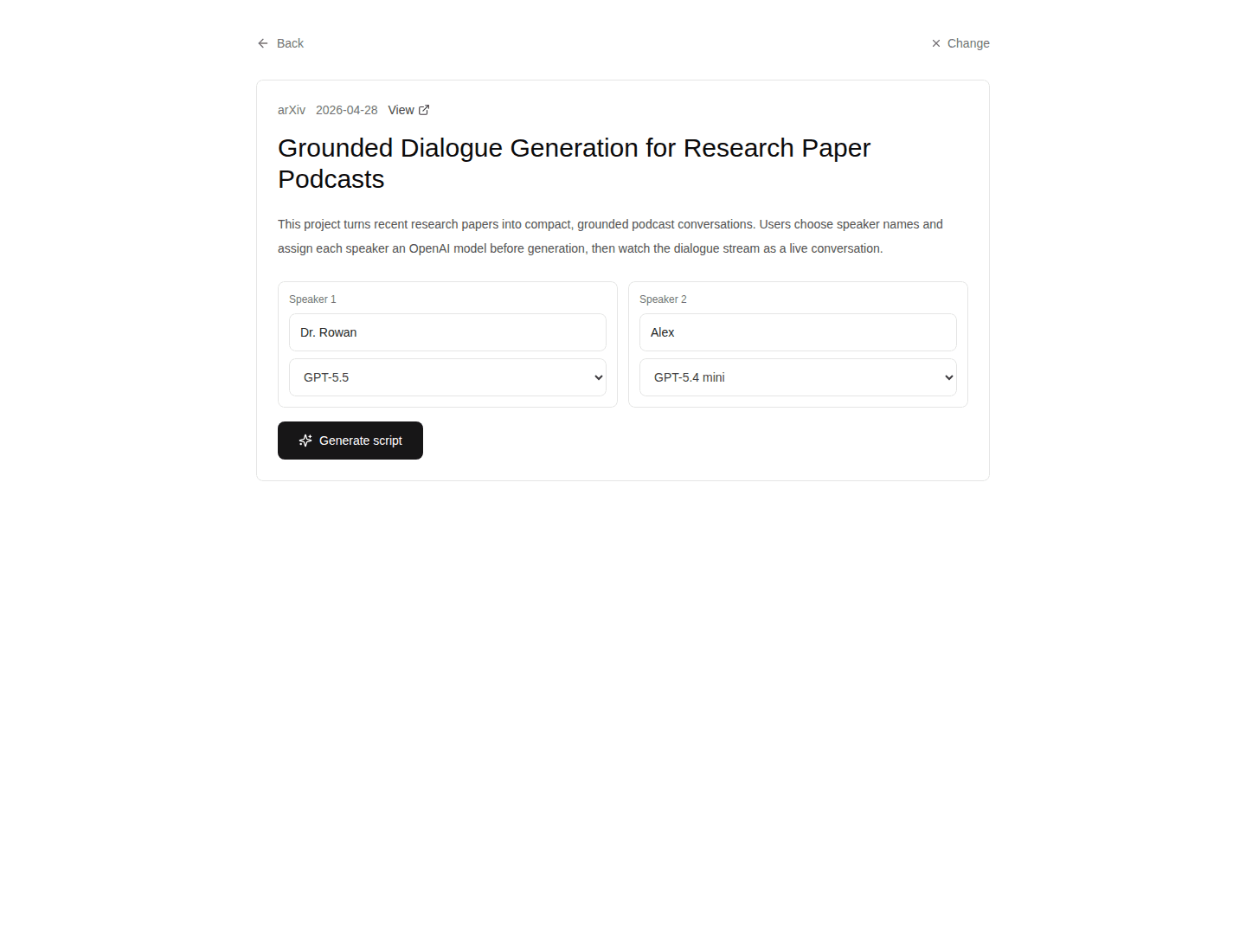
The production screen treats generation as a deliberate second step. After a paper is selected, the user names both speakers and chooses a separate OpenAI model for each one. The repo currently exposes GPT-5.5, GPT-5.4, GPT-5.4 mini, GPT-5 mini, and GPT-5 nano as speaker model options.
Script generation creates an 8-turn grounded dialogue from the selected paper. Each turn has a defined conversational job, moving from problem setup to contribution, method, evidence, limitation, and takeaway. The generated script can then be replayed with a live dialogue animation.
The prototype now demonstrates a complete handoff from paper discovery to replayable, exportable podcast script.
The output is designed to leave the app cleanly. Users can download a plain text script or an ElevenLabs-compatible JSON file, which makes the prototype useful as a bridge between research discovery and audio production rather than only as an on-screen demo.
The architecture remains intentionally small. Paper discovery is fetched live from arXiv, search results use the abstract directly, script generation runs on demand through a Node 20 Express API and the OpenAI Responses API, and the app stores nothing. There is no auth, no paper history, no episode library, no background jobs, and no database.