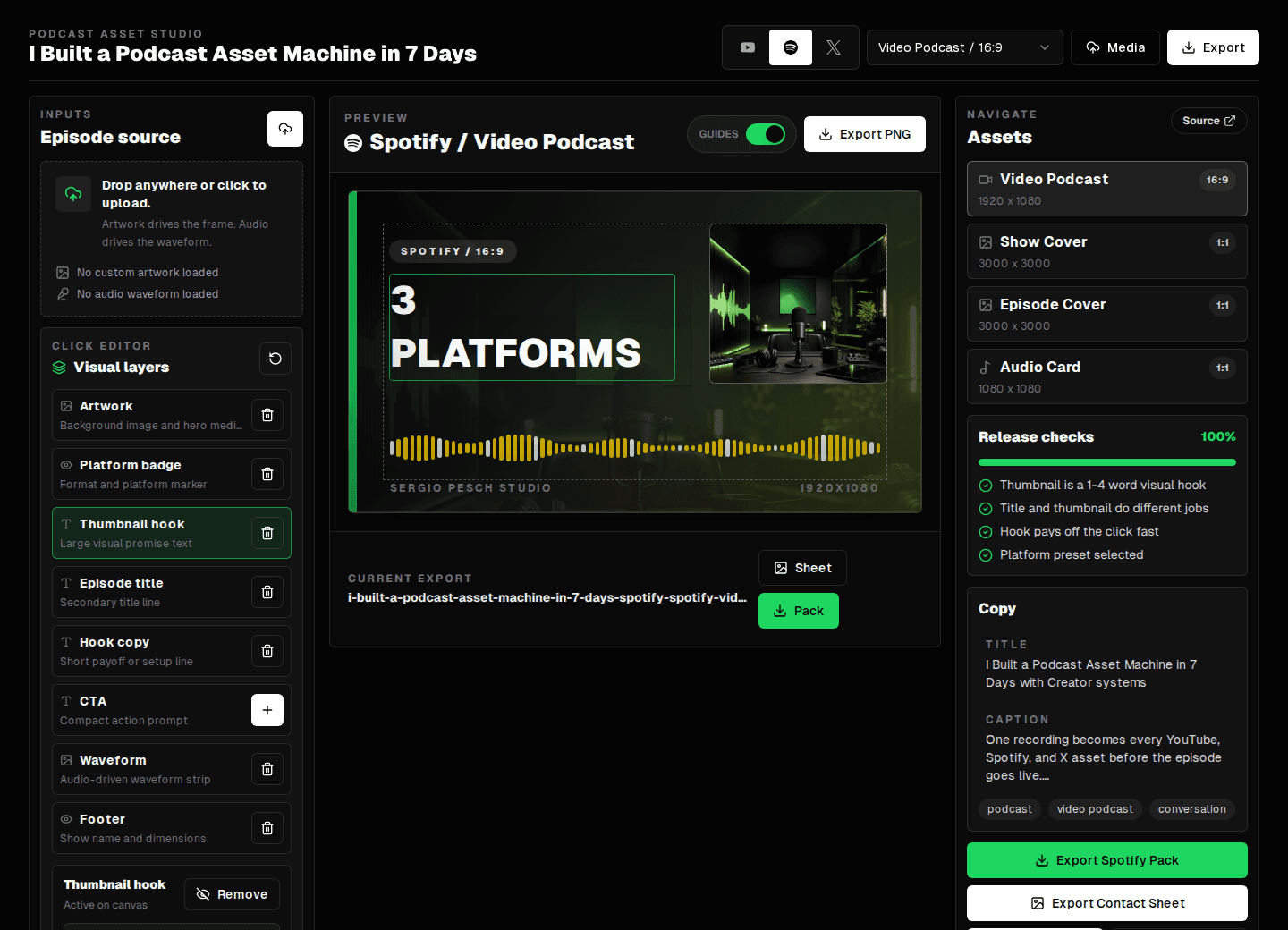
Podcast Asset Studio began from the familiar podcast problem: audio-first content often needs a visual layer before it can travel well on video and social platforms.
The project moved from making podcast waveforms into solving the bigger publishing bottleneck: packaging one episode for every platform.
The old version was closer to a waveform generator. The current repo has grown into a one-page production workspace for turning one episode idea into a platform-ready launch pack.
The app focuses on YouTube, Spotify, and X. Each platform has its own asset set: long-form masters, Shorts frames, thumbnails, podcast playlist art, video podcast covers, square audio cards, vertical clips, launch cards, and quote cards.
The useful unit is no longer a single visualizer. It is a complete launch pack: format, artwork, waveform, copy, brief, and export checks.
That scope makes the product more useful. Instead of exporting one generic image, the user chooses a platform and asset format, edits the visual layers, checks the copy, and exports the right PNG for the selected destination.
The visual editor is built around practical podcast packaging. It has artwork, platform badges, headline hooks, episode titles, hook copy, CTAs, waveform strips, and footer details. Layers can be selected, toggled, and reflected in the preview, export, contact sheet, and JSON production brief.
Audio still matters, but it is now one layer in a larger workflow. Users can upload audio for decoded waveform rendering, or rely on the studio fallback waveform when no source audio is available.
The studio intentionally supports YouTube, Spotify, and X, then validates those outputs instead of pretending to cover every creator platform.
The repo also treats release quality as part of the product. Export QA downloads and verifies 15 generated PNGs: 12 platform assets plus contact sheets for YouTube, Spotify, and X. It checks dimensions, file size, nonblank pixels, and unsupported platform copy.
The result is a tighter creator tool. It is not trying to be a full video editor; it is the packaging step between finishing a conversation and having enough visual material to publish it cleanly.