Plant Watering System started as the obvious intervention: plants die because people forget to water them, so build something that reads soil moisture, controls a pump, watches the reservoir, and sends an alert before the system quietly fails.
The project is no longer only about remembering to water a plant. It is about designing the whole plant-care unit.
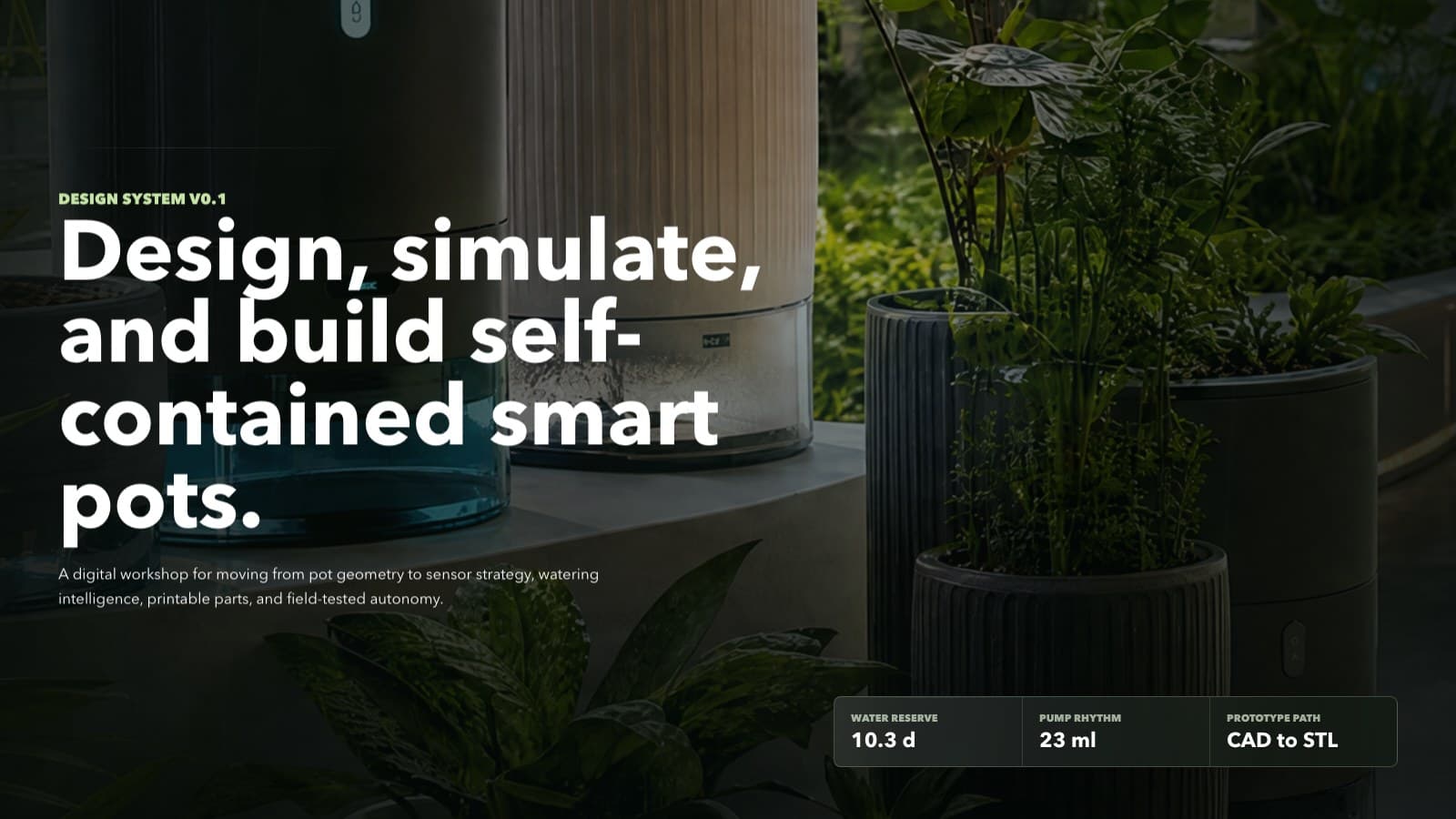
The repo has since grown into a more ambitious product surface. The current app is a public React and Vite studio for designing, simulating, and eventually building self-contained smart plant pots.
The first screen frames the project as a design system rather than a gadget. From there, the studio moves through pot geometry, electronics, environmental simulation, and a final build path for moving toward a printable prototype.
The useful product surface is the bridge between digital design and a physical pot that can be printed, wired, tested, and maintained.
The CAD page treats the pot as a machine with shape, reservoir capacity, sensor routing, tubing, electronics access, and material choices. It uses Three.js to make the concept visible while the controls expose the parameters that matter.
The simulation layer models practical plant-care variables: plant profile, water demand, reservoir autonomy, ambient temperature, humidity, light, target moisture, and pump dose. It is not pretending to be a finished physics engine yet; it is the foundation for one.
The hardware direction is deliberately serviceable. The repo points toward ESP32-S3 control, capacitive soil moisture sensing, reservoir level detection, environment sensing, and a peristaltic pump so the fluid path stays maintainable.
The long-term system is intentionally modular: reservoir, sensing, electronics, fluid delivery, firmware, and agent-facing telemetry.
That matters because this is not just an IoT dashboard problem. A useful self-contained pot has wet and dry areas, cleaning access, overflow strategy, printable split lines, calibration, fault detection, and alerts that arrive before the plant is already stressed.
The next meaningful milestone is to connect the studio to real production artifacts: parametric CAD generation, STL export, a bill of materials, firmware configuration, wiring notes, and validation plans for a first physical smart pot.